Tuesday, February 17, 2015

Carnival in Tobago, Trinidad & Tobago

We were fortunate to have made it in time for Carnival which was held on the 16th & 17th of February 2015. We heard that it is better to go on Tuesdays, and so we did.

The Trinidad and Tobago Carnival is an annual event held on the Monday and Tuesday before Ash Wednesday. The event is well known for its participants' colourful costumes and exuberant celebrations which begin right after Christmas. Here's some info about its origin..

"Like the cosmopolitan mix of peoples and cultures that shaped the island, Trinidad's Carnival has many influences. The Spanish and English colonial powers, French planters, African slaves, Indian indentured labourers, and the many other ethnic groups that settled here have all left an indelible mark on the festival.

In 1783 the French brought their culture, customs and Carnival, in the form of elaborate masquerade balls, to Trinidad along with African slaves. The period stretching between Christmas and the start of Lent was a time for feasting, fancy dress balls and celebration for both the French and British.

Banned from the festivities, slaves in the barrack yards would hold their own celebrations mimicking their masters' behaviour while incorporating rituals and folklore. Once slavery was abolished in 1838, the freed Africans took their Carnival to the streets and, as each new immigrant population entered Trinidad, a new flavour was added to the festivities. Today, our diverse culture has influenced the music, food and traditions of Carnival."
 
We thoroughly enjoyed watching the people dance in their colourful costumes on the street. The energy was fantastic! Even though we heard its not as elaborate as the one in Trinidad... it was a great experience for us nonetheless.
 
Carnival Time
King George and I


Read More »

Friday, February 13, 2015

Tobago, Trinidad & Tobago

Beautiful sunset from our anchorage in Store Bay
We finally made it to the Caribbean! 

Trinidad and Tobago is the southern most island in the Caribbean, situated northeast of Venezuela (just 11km away). It was a 3 day sail from British Guyana. We departed at the river mouth of Baganara on the 10th February 2015 and arrived on the eve of Valentine's day.

Our initial heading was towards Chaguaramas, Trinidad. However, Alex calculated that if we stayed our course, we would arrive after dark. It would be too risky for us (a single prop) to maneuver into an unfamiliar port in the middle of the night. We would also have to deal with customs and immigration after working hours which would most likely incur overtime charges.

Without much deliberation, we changed our course and headed into Tobago instead. We arrived in Scarborough at 15:30pm. By the time we set our anchor, prepared the dinghy and found our way to Customs and Immigration's office, it was closed! Even though we arrived before closing time. After many attempts to contact the officers, we were advised to come in the next morning.

The anchorage we were in (opposite the Port) was not a good one. It was too rolly and we weren't sure if the anchor would hold overnight. We moved again after speaking to some locals and a yacht nearby, and picked up a mooring (N 11.10.756 W 60.44.150) beside it to stay the night.

The next day, we headed off to the Customs and Immigration's office as advised. Surprise, surprise, it's not open (again)! We waited 2 hours outside the door, and finally an officer rocks up at 11:00am. We were not happy cruisers!

After clearing in, we moved to Store Bay (or Milford Bay on the charts) and picked up a mooring (N 11.09.497 W 60.50.501). It was a much better anchorage except for the occasional jet skiers that come way too close creatng wakes that makes us feel like we're back in the big ocean. On the bright side, we were able to get free Wifi on board. So, yay!


View of Raptor from the beach
Read More »

Thursday, February 5, 2015

Essequibo River, British Guyana

Raptor in Essequibo River
Guyana is the only South American nation in which English is the official language. It is bordered by the Atlantic Ocean to the north, Brazil to the south and southwest, Suriname to the east and Venezuela to the west.

Essequibo is the largest river in Guyana and the largest river between the Amazon and Orinoco. It flows from the Acarai Mountains near the Brazil-Guyana border 1,010km northward through forest and savannah into the Atlantic Ocean.

We set off from Domburg, Suriname on 3rd February 2012 and anchored opposite Bartica (N 06.23.964 W 58.37.037) the next day. It was approximately 265 nautical mile ride. We landed the dinghy at Cool Breeze, cleared in and spent a day exploring the town. 

Streets in Bartica
Street near Cool Breeze
Bartica occupies a unique natural location in the north-central Guyana where the mighty Essequibo, Mazaruni and Cuyuni rivers meet. Considered the "Gateway to the Interior". 

Even though this is the launching point for Guyana's diamond and gold miners, the place is not well developed and a little disappointing to find garbage everywhere. 

It's unparalleled natural location is one of the most intriguing sites for a town. The name 'Bartica' comes from an Amerindian word meaning 'red earth', is abundant in the area.
 
What about them?
Unfortunately garbage everywhere
We departed Bartica for Baganara Resort on 6th February. We motored 15 nautical miles up the river.

Here are some photos of the river on our way to Baganara Island (approx. 40nm inland). Apparently this about as far up the river we can go with a sailing vessel. Smaller & more powerful boats are needed to go further up through the rapids.

The rocks looks like a huge crocodile
A tiny island in the middle of the river with a bridge between the private property and an overgrown shipwreck on the right
It's calm in the river
Reflections
Baganara Resort
Baganara Island Resort on Baganara island (about 40nm up the Essequibo river). A peaceful place away from the city with nature all around. Had fun playing pool and table tennis all day. There are hammocks, chess board, frisbees, football, volleyball & kayaks too. All these to ourselves! 

I guess we came at a good time (off peak season). Even though the entrance to this river was pretty tricky with all the rocks, wrecks, stakes, shallow areas and limited charts, its definitely a nice place for some R&R. 

We anchored just off the Resort (N 06.20.027 W 58.35.545) for 4 days.
Our crew David
Monkeying around
Red Howler Monkey
A little settlement by the river
Exploring in the dinghy
Mangroves
Beautiful isn't it?

We departed Baganara for Bartica on the 10th February to clear out, and anchored 18 nautical miles (N 06.48.169 W 58.30.562) from the river mouth for the night. We headed off for Trinidad and Tobago the next day.
Read More »

Sunday, February 1, 2015

Friends in Suriname

Spent a day with our new friend Anthony, nephew of our friend Chunny whom we met in French Guyana. He brought us to visit his family's farm in Commewijne which was lovely. So many fruits & veggies. We had such a great time! Thanks Anthony!


Not sure what these are but aren't they pretty?
Capsicums
Four Angle Bean
Tomatoes
Avocados
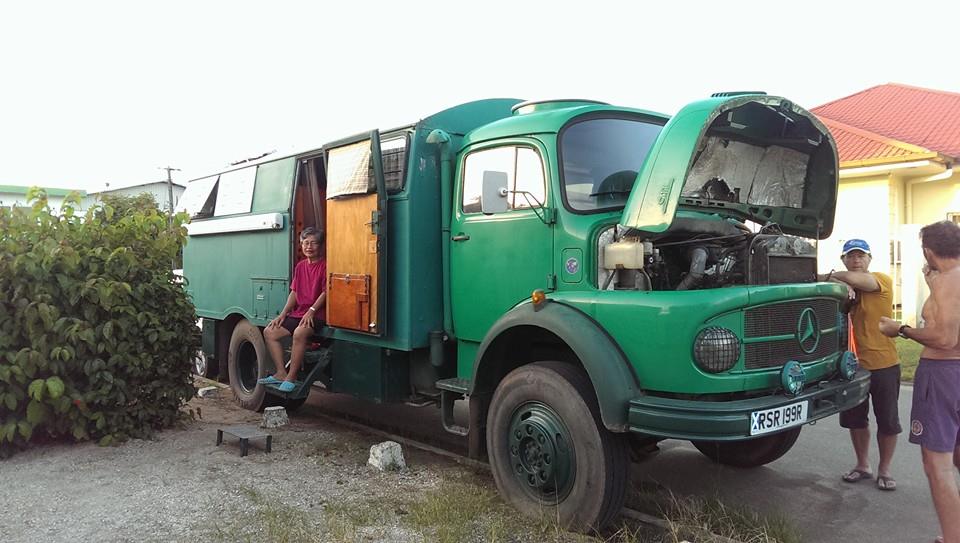
We also met up with Philippe and Chunny (our overlander friends) and finally had a tour of their Big Green Motorhome, the one in which they will be travelling South America with.


Motorhome
Phillipe, Chunny, David, Alex and I
Dinner at a Chinese Restaurant in town. I wish I could remember the name of it now. 

Dinner with Philippe, Chunny, Anthony & David
The day before we departed Suriname, we invited our friends aboard Raptor for dinner.

See you again!

Read More »

Wednesday, January 28, 2015

Neotropical Butterfly Park, Suriname

We also visited the Neotropical Butterfly Park in Wanica, which is one of the largest butterfly farms in South America as well as the first butterfly farm in Suriname. 

This farm has about 20 different types of butterflies and exports the pupas to other farms overseas (mainly Europe). It also exports red-footed tortoises and boa constrictors (sold as pets). 

This little frog ate a butterfly
Suriname
Lands on my finger
Suriname
Pink Mush - Butterfly Food


Suriname

Suriname

Suriname
Different types of caterpillars
Packaging the pupa's for export
Read More »

Thursday, January 22, 2015

Suriname - A Melting Pot of Cultures


Suriname is a former Dutch colony is located in the northern coast of South America, surrounded by Guyana (in the west), French Guyana (in the east) and Brazil (in the south). Its the smallest independent country in the South American continent.

We arrived in Domburg, a small village situated 6 miles up from Paramaribo on the Suriname river, the evening of 22nd January 2015. It was a day's sail (approx. 125 nautical miles) from St Laurent, Maroni river.

We picked up a mooring (N 05.30.380 W54.02.041) at $8 EUR/day opposite the Domburg Habour Resort. A small marina with 14 moorings, a floating pontoon, showers and a restaurant. At that time, they were building a swimming pool too!

Nice day to rest & relax
Wild Water Lillies somewhere between Domburg & Paramaribo
Here we rented a car for $10/EUR a day from a local and drove into Paramaribo, the capital of Suriname, which is also a UNESCO World Heritage Site for its colonial buildings.


The building style is a collection of European architecture with Surinamese influences. The city centre is very charming with its old wooden, colonial houses. It felt like we were in Europe!


Other parts of Paramaribo reminded me of home (Malaysia), with its many mini-markets, busy traffic and crazy drivers.


The inhabitants are a mixture of its indigenous people and descendants from Europe (primarily Dutch and English), Asia and Africa. Lots of Indians, Chinese, Indonesians (Javanese), Creoles and Africans.


It's a very culturally diverse population. There are temples, churches & mosques everywhere. It's one of the last few countries to have a mosque next to a synagogue. Living in peace and harmony.

Mosque & Synagogue - Side by Side
Temple
More Temples
The Synagogue
Mosque

The one thing I really wanted to do but missed out on there was to volunteer at the Green Heritage Fund Suriname. It's a charitable non-profit organization established in 2005. 

There are several programs established with the idea to reinvest the all earnings in the programs to help improve the fate of animals and the environment. 

Their vision is "to create a society that consciously works towards the continued improvement of its environment and the promotion of a green, clean and healthy Suriname". Wonderful! 

The program that really caught my attention was the Xenarthra program which involves rescuing, sheltering, caring, rehabilitating and releasing sloths, armadillos and anteaters, i.e. taking care of these orphaned and distressed animals until they are healthy and ready to return to the forest. 
 
I really wanted to volunteer for that because I really like sloths, perhaps it's cos I feel like one. Haha! I corresponded via email with the founder and director Monique Pool several times, however, due to timing constraints, we were not able to make it happen.

They also have a Dolphin program to collect basic data on the wild Sotalia Guianensis dolphin population in the estuary of the Suriname River. These dolphins look similar to the bottlenose dolphins but are smaller in size. The aim of this program is to increase knowledge and awareness of the wild dolphin habitat and populations, to help protect them and make better environment decisions.

So if you're ever in Suriname, do check them out!
Read More »